In 2020, the University of Civil Engineering began transitioning its training model to align with the Vietnamese National Qualifications Framework.
The university's conversion training model includes three levels of qualification corresponding to the Vietnamese National Qualifications Framework, and the diploma awarded upon graduation is:
- Level 6 - University level: Minimum study load of 120 credits, graduation is awarded a bachelor's degree.
- Level 7 - Master's degree level, including:
+ For a master's degree, with a minimum of 60 credits, students are awarded a master's degree.
+ For the Engineer/Architect level, with a minimum of 60 credits (referred to as the new Engineer level), students are awarded an Engineer/Architect degree.
After graduation, students can transfer their knowledge between engineering/architecture degrees and master's degrees.
- Level 8 - Doctoral level: Upon successfully defending their dissertation, students will be awarded a Doctor of Philosophy degree.
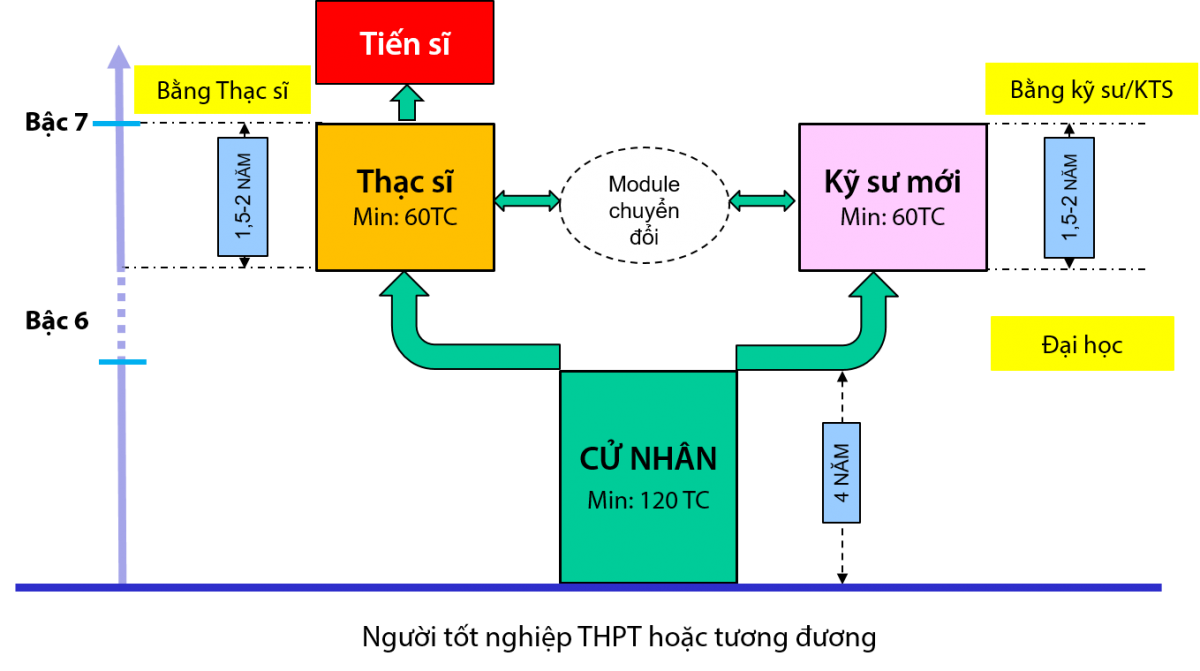
The bachelor's program is designed for a duration of 4 years, with a fundamental focus and broad range of training. The program equips students with foundational scientific and technical knowledge and basic professional skills to adapt to various jobs within their field of study. Graduates of the bachelor's program achieve level 6 – University level – in the Vietnamese National Qualifications Framework.
After obtaining a bachelor's degree, students can either start working or continue their studies in a master's or engineering program, which typically takes 1.5-2 years.
The new engineering program is designed for engineering/architecture fields, training students according to societal needs, and closely collaborating with businesses, employers, and recruiters. The program equips students with advanced technical knowledge and specialized professional skills, immediately meeting the demands of the job market. Graduates of the new engineering program achieve level 7 in the National Qualifications Framework and can receive a master's degree after completing some bridging courses.
The training was organized in two phases:
- Phase 1: Bachelor's degree training, with approximately 130 credits, a training duration of 4 years, and an output standard of level 6 according to the Vietnamese National Qualifications Framework, leading to the awarding of a bachelor's degree.
- Phase 2: Training of new master's or engineering students, with a knowledge volume of over 60 credits, a training duration of 1.5-2 years, and an output standard of level 7 according to the Vietnamese National Qualifications Framework, applicable to the same or related fields of study, awarding a master's or engineering/architectural degree.
In cases where students study the same major/specialization in the two aforementioned stages, the training time can be shortened to 5 to 5.5 years under an integrated program. This new integrated bachelor-master or bachelor-engineer program for the same major/specialization awards two degrees: bachelor's and master's, or bachelor's and engineer/architectural, to graduates.
With the new training model implemented above, starting from the 2020 enrollment period, the University of Civil Engineering will provide society with high-quality human resources in most of the currently offered majors/specializations at diverse and flexible levels, suitable to the needs of the labor market as well as the study plans of each student. With the orientation of building a training program based on the CDIO framework, updating and referencing programs of developed countries to integrate internationally, and closely linking with businesses on the traditional foundation of the University of Civil Engineering, the training model transitioning according to the National Qualifications Framework is the basis for further improving the quality of training and orienting training activities to a new stage of development commensurate with the position of a leading educational institution in the field of construction and architecture in Vietnam.