INFORMATION TECHNOLOGY/INFORMATION SECURITY
(7480201-02)
ADMISSIONS 2026
1. Admission quotas, subject combinations for admission, and admission codes.
|
|
Six admission methods. For detailed information, please REFER HERE. |
|
Admission code |
Admission code |
Name of major/specialization |
Square examination recruitment |
Name of the method examination recruitment |
Admission combination code |
Target |
| 7480201-02 | 7480201 |
Information Security major |
100 |
PT1 span> (High School Graduation Exam Results) |
A00, A01, C01, D01, D07, X06, X26 |
50 |
|
200 |
PT2 (Record of Academic Results) |
A00, A01, C01, D01, D07, X06, X26 |
||||
|
402-TSA |
PT3 (Assessment of thinking skills_Hanoi University of Science and Technology 2025-2026) |
D00 |
||||
|
402-SPT |
PT4 (Competence Assessment_Hanoi University of Education 2026)
|
SP1, SP2, SP4 |
||||
|
417 |
rgin-bottom:11px"> PT5
(Computer-based university entrance assessment_National Examination Center 2026) |
VS1, VS2, VS4 |
||||
|
301 |
PT6 Direct admission |
TT |
Subject combinations for admission:
Assessment based on academic transcripts and high school graduation exam scores.
Combination 1: A00: Mathematics, Physics, Chemistry
Combination 2: A01: Mathematics, Physics, English
Combination 2: C01: Mathematics, Physics, Literature
Combination 3: D01: Mathematics, Literature, English
Combination 4: D07: Mathematics, Chemistry, English
Combination 5: X06: Mathematics, Physics, Informatics
Combination 7: X26: Mathematics, Computer Science, English
Assessment of thinking skills (organized by Hanoi University of Science and Technology)
Combination 8: K00: Mathematical Thinking, Reading Comprehension, Scientific Thinking/Problem Solving
Competency assessment (organized by the University of Education)
Combination 9: SP1: Mathematics, Physics, Chemistry
Combination 10: SP2: Mathematics, Physics, English
Combination 11: SP4: Mathematics, Literature, English
Computer-aided input assessment (V-SAT)
Combination 12: VS1: Math, Physics, Chemistry
Combination 13: VP2: Mathematics, Physics, English
Combination 14: VP4: Mathematics, Literature, English
Admission cutoff score in 2025: 25.35 points
2. Introduction to training specialization, training duration, and degree awarded.
2.1. Introduction to the major
- Information Security is a leading field of study within the Information Technology group, focusing on in-depth training in system security, network security, cyberattack prevention, and data protection. With the explosion of digital transformation, information security has become a mandatory requirement for all organizations, businesses, and government agencies.
- The Information Security specialization program at Hanoi University of Civil Engineering equips students with a solid foundation of knowledge in Information Technology in general and in-depth skills in Information Security. Students are trained to be able to design, operate, monitor, and protect information systems in various environments, while also developing skills in analyzing, assessing risks, and responding to cybersecurity incidents.
- Information Technology Engineers specializing in Information Security are trained to have a broad knowledge base in Information Technology, with in-depth expertise in the field of Information Security. Graduates are capable of working in various positions such as information security risk analysis, security incident handling, and designing secure architectures for network systems and applications. In addition, students are equipped with soft skills such as communication, teamwork, and self-learning skills to adapt to the rapid changes in the technology field.
- Students will receive in-depth training in Information Technology and Information Security, and will not study subjects related to the Construction field (e.g., drawing, concrete, steel). Applicants to the program do not need prior knowledge of programming or computers.
2.2. Training and degree awarding time
Engineer (equivalent to a master's degree: 4.5 ÷ 5 years)
3. Knowledge and skills acquired after graduation
3.1. Regarding knowledge
- Basic knowledge of social sciences, economic sciences, and political science.
- Basic knowledge of mathematics and natural sciences, meeting the requirements for acquiring professional educational knowledge and the ability to study at a higher level.
- Fundamental knowledge of cryptography, from basic to advanced levels, for application in system security and the development of secure protocols.
- In-depth knowledge of information security: threat analysis, risk assessment, incident handling, computer network security, system and application security.
- Knowledge of digital forensics helps in tracing and analyzing documents contained in digital devices related to cybercrime.
- Knowledge of network technology, operating systems, information systems, and related emerging technologies such as digital transformation and artificial intelligence in security.
- Acquiring knowledge of cybersecurity laws helps to understand the limits and rights when working with data and systems, thus avoiding legal violations.
3.2. Regarding skills
- In-depth expertise in information security, computer networks, and information systems.
- Skills in identifying, analyzing, and resolving cybersecurity incidents.
- Skills in deploying security technology solutions for businesses and organizations.
- Basic programming skills and application security programming.
- Skills in researching, learning, and updating new technologies in the field of information security.
- Effective communication and presentation skills, teamwork, and professional work management.
4. Scholarship and academic support opportunities
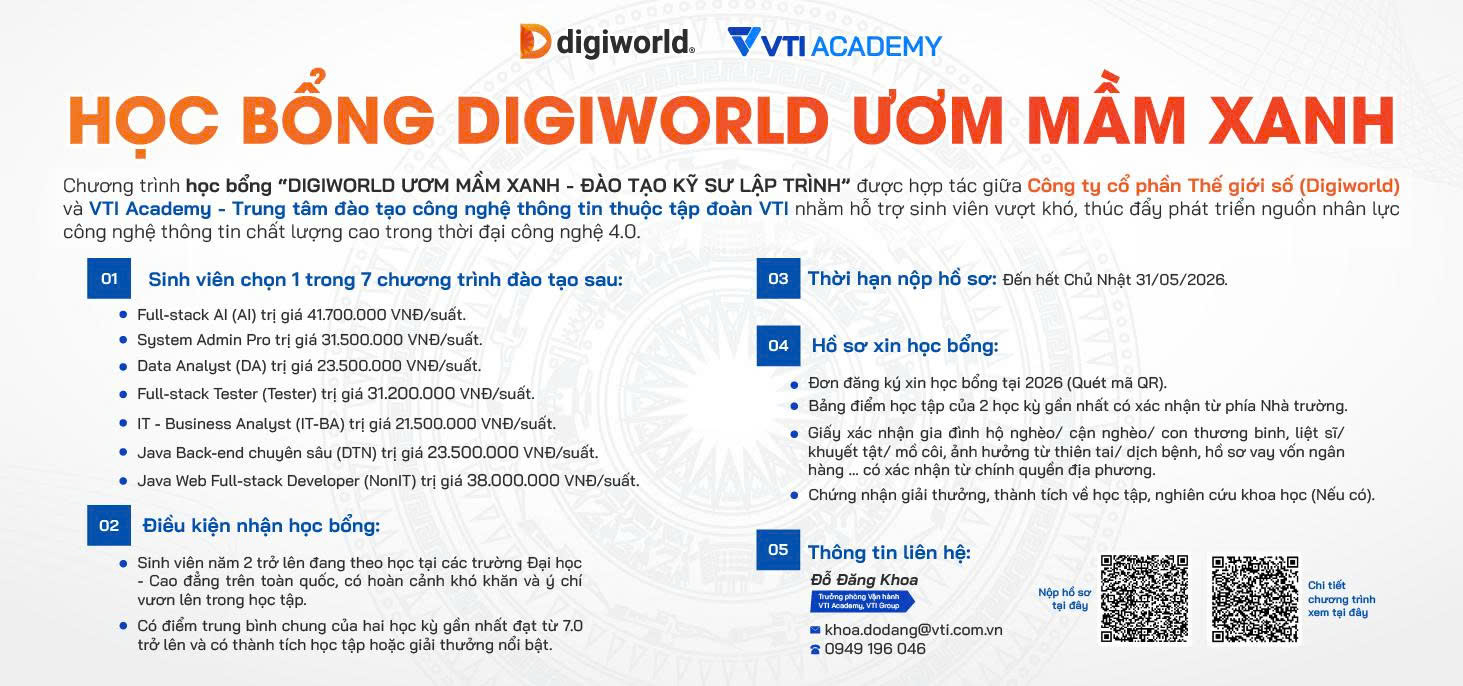
- Tuition fee reductions and waivers are offered for foreign language (English, Japanese), programming, and network administration courses at partner institutions of the Faculty of Information Technology.
- There are opportunities to receive scholarships each semester depending on academic performance.
- It is possible to pursue a double degree or a second degree in other fields or specializations at the school.
- Free participation in joint courses taught by partner businesses of the Faculty of Information Technology.
- Opportunities to visit and attend academic seminars, and gain practical experience through internships at partner businesses.
- Students have the opportunity to join the Faculty's Student Clubs, participate in sports, arts, extracurricular activities, and scientific research.
- You will study and conduct research in a dynamic and creative environment with enthusiastic lecturers who possess deep expertise and practical experience.
- Students have the opportunity to participate in scientific research activities with faculty members, attend collaborative training programs between the Faculty of Information Technology and technology companies, and participate in competitions related to software programming, information security, and the Student Informatics Olympiad, etc.
- There are opportunities for advanced postgraduate studies both domestically and internationally.
5. Job opportunities
After graduation, IT engineers specializing in Information Security can work in positions such as:
- Information security risk analyst.
- Information security incident response specialist.
- Information security architecture specialist.
- Cybersecurity specialist.
- Application Information Security Specialist.
- System Information Security Specialist.
- After gaining experience, they can take on information security management roles at agencies, organizations, and businesses.
Although approximately 2,000 students graduate in Information Security each year, only a limited number meet the actual requirements of businesses. Therefore, the Information Security sector is currently experiencing a shortage of high-quality personnel, creating broad and diverse job opportunities for graduates.
Information Security Engineers can work in: Banks, data centers, network service providers, technology companies, and government organizations in the following positions:
- System administration and security specialist.
- Malware analyst and prevention specialist.
- Software security specialist.
- Information security incident inspectors, reviewers, and incident handlers.
- Cryptography specialist, cybercrime investigator.
- Information systems consultant, analyst, and designer.
- Security application developer.
In addition to finding employment immediately after graduation, Information Security students can also continue their studies to obtain Master's or Doctoral degrees, conduct scientific research, and become lecturers, contributing to the training of the next generation of engineers.
6. Contact:
- Faculty of Information Technology
- Address: Room P410, Building A1 - Hanoi University of Civil Engineering.
- Hotline: 0979 311 424
- Email: congnghethongtin@huce.edu.vn
- Website: fit.huce.edu.vn
- Fanpage (Students can inbox and receive direct admissions advice from faculty members of the department): https://www.facebook.com/cnttdhxd
- In-person Admissions Counseling (answering questions about quotas, minimum scores, cutoff scores, tuition fees, etc.). Click on the icon you want to receive counseling from:
- Consultation via Facebook Messenger:

- Consultation via AI chatbot virtual assistant.
 a, sans-serif;">
- Consultation via Facebook Messenger:
- Or contact directly:
-
- Dr. Le Thi Thuy Duong: 0904 310 277
- Dr. Nguyen Ha Duong: 0987567271
- Assoc. Prof. Dr. Pham Duc Thoan: 095130218
Please refer to other majors/specializations within the Faculty of Information Technology.
- Computer Science
- Information Technology
- Multimedia Technology major
- Civil Engineering major, specializing in Construction Informatics.
- Information Security Major (New)